
Merging Unit
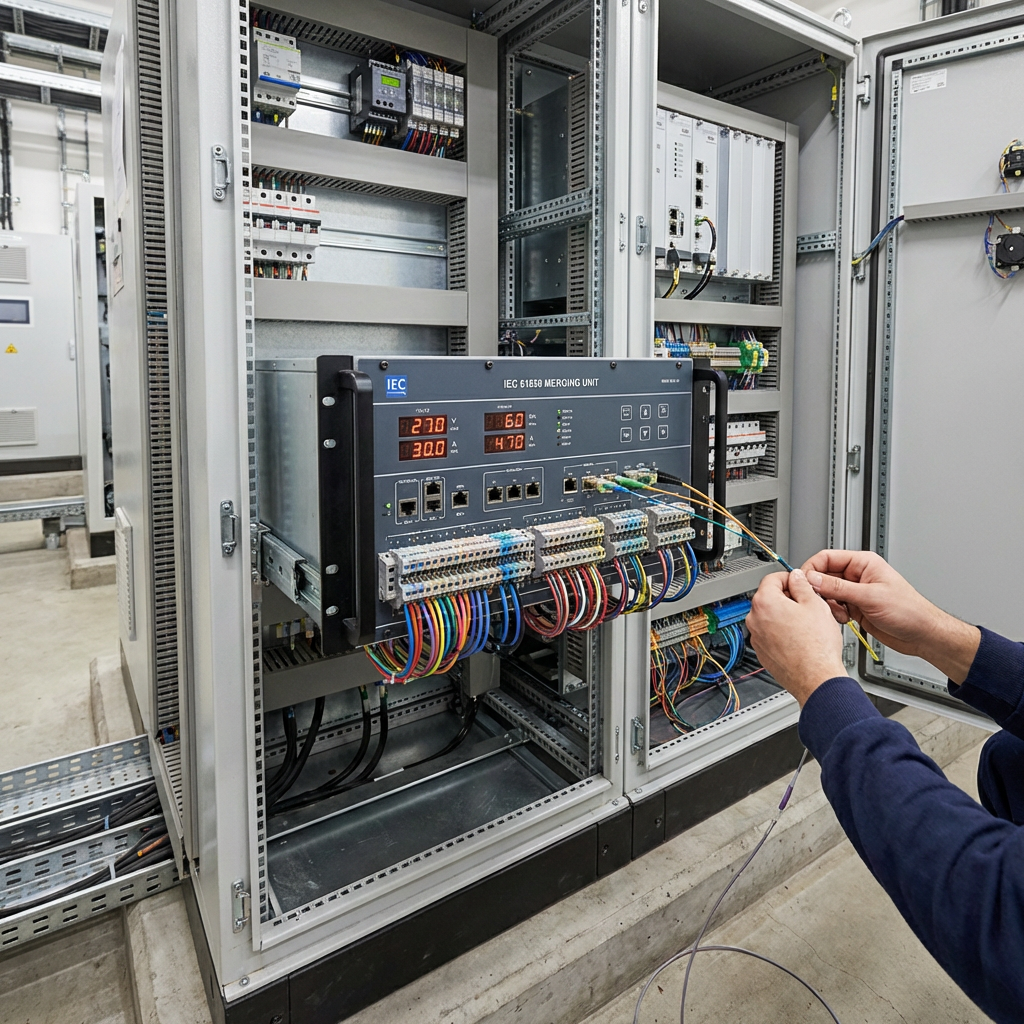
A Merging Unit (MU) is a critical device used in modern digital substations to convert high-voltage analog signals from instrument transformers into precise digital data for protection, control, and monitoring systems. It acts as the interface between the primary electrical equipment in a substation yard and the intelligent electronic devices (IEDs) inside the control room.
Merging units are a key component of substations designed according to the IEC 61850 standard, particularly in process bus architectures.
Why Are Merging Units Important?
Traditional substations rely on copper wiring to transmit current and voltage signals from Current Transformers (CTs) and Voltage Transformers (VTs) to protection relays. This approach:
- Requires extensive copper cabling
- Increases installation and maintenance costs
- Is vulnerable to electromagnetic interference
- Reduces flexibility and scalability
Merging units replace bulky copper wiring with fiber-optic Ethernet communication, enabling faster, safer, and more efficient digital data transmission.
How a Merging Unit Works
The merging unit performs the following key functions:
1. Signal Acquisition
It receives analog inputs from:
- Current Transformers (CTs)
- Voltage Transformers (VTs)
- Non-conventional instrument transformers (NCITs)
2. Analog-to-Digital Conversion
The analog signals are sampled and converted into digital values using high-precision ADCs (Analog-to-Digital Converters).
3. Time Synchronization
Accurate time stamping is essential for protection schemes. Merging units use synchronization protocols such as:
- IEEE 1588 Precision Time Protocol (PTP)
- IRIG-B
This ensures all devices in the substation operate with microsecond-level accuracy.
4. Data Transmission
The digital data is packaged into Sampled Values (SV) messages and transmitted over Ethernet to protection relays and control systems using the IEC 61850 process bus.
Key Features of a Merging Unit
- High sampling accuracy
- Real-time data transmission
- Fiber-optic communication
- Reduced copper wiring
- Enhanced safety (low-voltage control circuits)
- Cybersecurity capabilities
- Compact and modular design
Types of Merging Units
Conventional Merging Units
- Interface with traditional CTs and VTs
- Convert secondary analog signals into digital format
Non-Conventional Merging Units
- Used with optical or electronic instrument transformers
- Directly receive digital or low-energy analog signals
Benefits of Using Merging Units
1. Reduced Installation Cost
Fiber-optic cables replace large bundles of copper wires.
2. Improved Safety
Lower risk of high-voltage exposure in control panels.
3. Higher Reliability
Less susceptibility to noise and signal degradation.
4. Scalability and Flexibility
Easier system expansion and reconfiguration.
5. Enhanced Monitoring
Enables advanced diagnostics and real-time condition monitoring.
Applications of Merging Units
Merging units are widely used in:
- Transmission substations
- Distribution substations
- Renewable energy plants
- Industrial power systems
- Smart grid infrastructure
They are fundamental to fully digital substations and Industry 4.0 power systems.
Merging Unit in a Digital Substation Architecture
In a digital substation, the merging unit is installed near the primary equipment in the switchyard. It forms part of the process level in the substation architecture:
- Process Level – Merging Units, sensors, circuit breakers
- Bay Level – Protection and control IEDs
- Station Level – SCADA and HMI systems
By digitizing signals at the source, merging units create a more efficient, reliable, and future-ready power infrastructure.
Detailed Technical Overview
A Merging Unit (MU) is a process-level Intelligent Electronic Device (IED) used in digital substations to acquire analog signals from instrument transformers, convert them into precisely time-synchronized digital samples, and transmit them over a process bus network.
It is a core component of substations designed under the IEC 61850 framework, particularly supporting Sampled Values (SV) communication as defined in IEC 61850-9-2 and IEC 61850-9-2LE implementation guidelines.
2. Functional Architecture of a Merging Unit
A modern merging unit consists of the following internal functional blocks:
2.1 Analog Input Stage
The MU receives inputs from:
- Conventional Current Transformers (CTs) – 1A / 5A secondary
- Conventional Voltage Transformers (VTs) – 110V / 63.5V secondary
- Non-Conventional Instrument Transformers (NCITs)
- Low-Power Instrument Transformers (LPITs)
Signal Conditioning Includes:
- Burden resistors (for CTs)
- Voltage dividers
- Isolation amplifiers
- Anti-aliasing filters
- Surge protection circuits
The analog front end must comply with IEC accuracy classes (e.g., 0.2, 0.5, 5P, PX).
2.2 Sampling and Analog-to-Digital Conversion
The conditioned analog signals are sampled by high-resolution ADCs.
Typical Sampling Parameters:
- Sampling rate:
- 80 samples per cycle (4 kHz at 50 Hz)
- 256 samples per cycle (12.8 kHz at 50 Hz)
- Resolution: 16–24 bit ADC
- Simultaneous multi-channel sampling
- Total Vector Error (TVE) compliance
The anti-aliasing filter cutoff frequency is designed below Nyquist frequency to avoid distortion.
2.3 Time Synchronization
Accurate time alignment is critical for differential protection, distance protection, and wide-area monitoring systems.
Merging units support:
- IEEE 1588 Precision Time Protocol (PTP)
- Power Profile (IEEE C37.238)
- IRIG-B (legacy systems)
- GPS clock input
Time accuracy requirement:
- ±1 µs or better for protection-grade applications
The MU timestamps each sampled data frame before transmission.
2.4 Digital Signal Processing (DSP)
The merging unit performs real-time processing such as:
- RMS calculation
- Frequency estimation
- Phase angle calculation
- Harmonic analysis
- Digital filtering
- Signal scaling and calibration
Advanced units may include:
- Saturation detection
- Data validation and plausibility checks
- Channel health diagnostics
2.5 Communication Interface
The MU transmits digitized data using Ethernet over fiber optics.
Protocols Used:
- Sampled Values (SV) – IEC 61850-9-2
- GOOSE (optional for status signals)
- MMS (for configuration and supervision)
Data is multicast over Ethernet frames using VLAN tagging and priority tagging (IEEE 802.1Q).
3. Sampled Values (SV) Message Structure
A typical SV frame contains:
- Application ID
- Sample count (SmpCnt)
- Configuration revision (ConfRev)
- Timestamp
- Instantaneous voltage values
- Instantaneous current values
- Quality attributes
For 50 Hz systems with 80 samples per cycle:
- 4000 samples per second
- Frame interval: 250 µs
- Network bandwidth: ~4–6 Mbps per MU
High-sampling-rate systems increase bandwidth accordingly.
4. Merging Unit Types
4.1 Standalone Merging Unit
- Installed near switchyard equipment
- Interfaces with conventional CT/VT
- Converts analog secondary signals to digital
4.2 Integrated MU (Process Interface Unit)
- Built inside protection relay or control IED
- Used in compact bay solutions
4.3 NCIT-Based Merging Unit
- Directly connected to optical or Rogowski coil sensors
- Lower energy secondary signals
- Higher bandwidth and safety
5. Redundancy and High Availability
Digital substations demand high reliability.
Redundancy Schemes:
- Dual Ethernet ports
- Parallel Redundancy Protocol (PRP)
- High-availability Seamless Redundancy (HSR)
- Redundant power supply modules
Network recovery time: 0 ms (seamless redundancy)
6. Performance Parameters
Key technical specifications typically include:
| Parameter | Typical Value |
|---|---|
| Sampling Rate | 4–12.8 kHz |
| ADC Resolution | 16–24 bit |
| Time Accuracy | ±1 µs |
| Latency | < 3 ms |
| Operating Temperature | -40°C to +70°C |
| Insulation Level | 2–5 kV |
| EMC Compliance | IEC 61000 series |
7. Cybersecurity Considerations
Since merging units operate over Ethernet networks, cybersecurity is critical.
Security features may include:
- Role-based access control
- Secure configuration (IEC 62351)
- Port disabling
- MAC filtering
- Encrypted management access
- Firmware integrity verification
8. Engineering and Configuration
Merging units are engineered using Substation Configuration Language (SCL) files defined in IEC 61850.
Files used:
- ICD (IED Capability Description)
- CID (Configured IED Description)
- SCD (Substation Configuration Description)
Engineering tools assign:
- MAC addresses
- VLAN IDs
- APPID
- Sampling rates
- Dataset configuration
9. Advantages Over Conventional Wiring
| Conventional System | Digital MU-Based System |
|---|---|
| Heavy copper wiring | Fiber optic process bus |
| Signal losses | High accuracy digital data |
| Complex testing | Simplified testing via network |
| High electromagnetic interference | Immune to EMI |
| Safety risks in panels | Low-voltage digital interface |
Copper reduction in large substations can exceed 70–80%.
10. Testing and Commissioning
Testing procedures include:
- Secondary injection testing
- Network packet analysis
- Time synchronization verification
- SV frame validation
- End-to-end latency testing
- Redundancy switching verification
Tools used:
- SV analyzers
- Network protocol analyzers
- PTP diagnostic tools
11. Applications in Modern Power Systems
Merging units are essential for:
- Busbar differential protection
- Transformer differential protection
- Line differential protection
- Wide Area Monitoring Systems (WAMS)
- Smart grid infrastructure
- Renewable integration substations
They enable full digital substation architectures compliant with IEC 61850.
12. Future Developments
Emerging trends include:
- Higher sampling rates for power quality analysis
- Integrated edge computing
- Condition-based monitoring
- AI-assisted fault diagnostics
- Process bus virtualization
Digital substations are evolving toward fully software-defined architectures, where merging units play a central role in measurement integrity and system reliability.
Conclusion
A merging unit is far more than a simple analog-to-digital converter. It is a high-precision, time-synchronized, network-enabled measurement system that forms the backbone of modern digital substations.
By enabling real-time, reliable, and accurate measurement data transmission over fiber-optic networks, merging units significantly enhance protection performance, operational efficiency, scalability, and cybersecurity of contemporary power systems.

 Grivon Power Solutions